This year we celebrated our artists’ recognition across major national awards. These awards have added meaningful momentum to their practices and affirmed the strength and impact of their voices on a national stage.
Explore the 2025 awards below:
Elisa Jane Carmichael, Finalist for the Telstra National and Torres Strait Islander Art Awards 2025
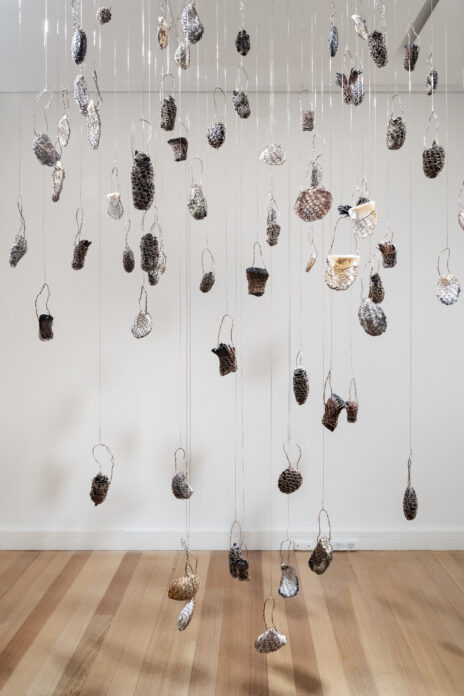
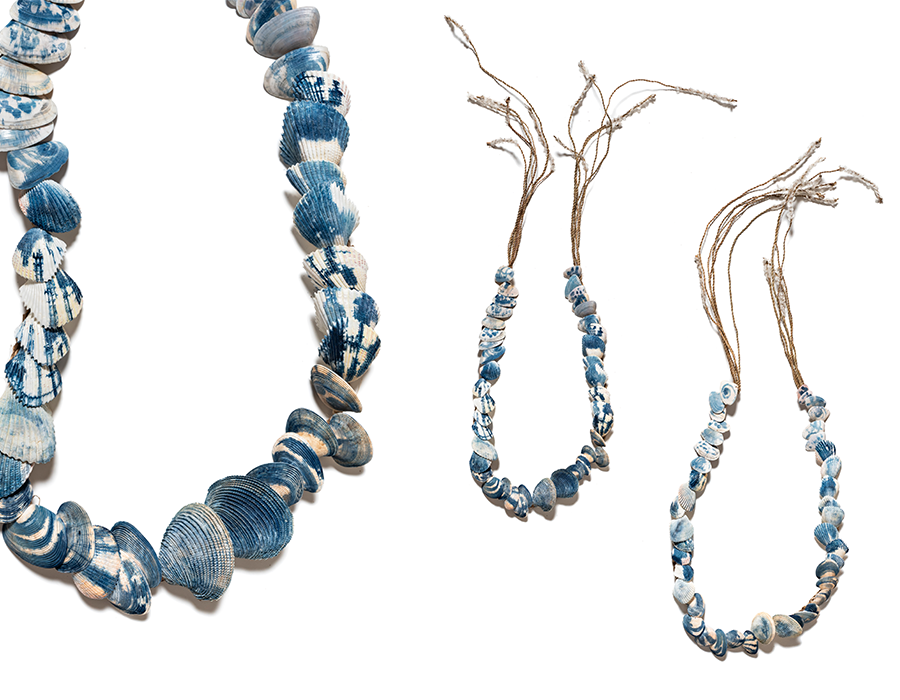
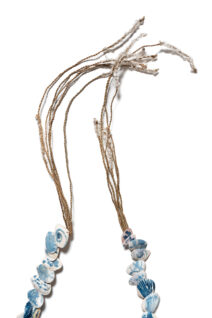 Threads that bind us weaves together Quandamooka people, place, sea country, sky country and Mother Earth as the strings flow into sculptural adornments. These adornments are worn on the body strung from shoulder to shoulder holding memories of Country, ceremony and spirit. These strings strengthen the continuous thread that binds us to our Ancestors.
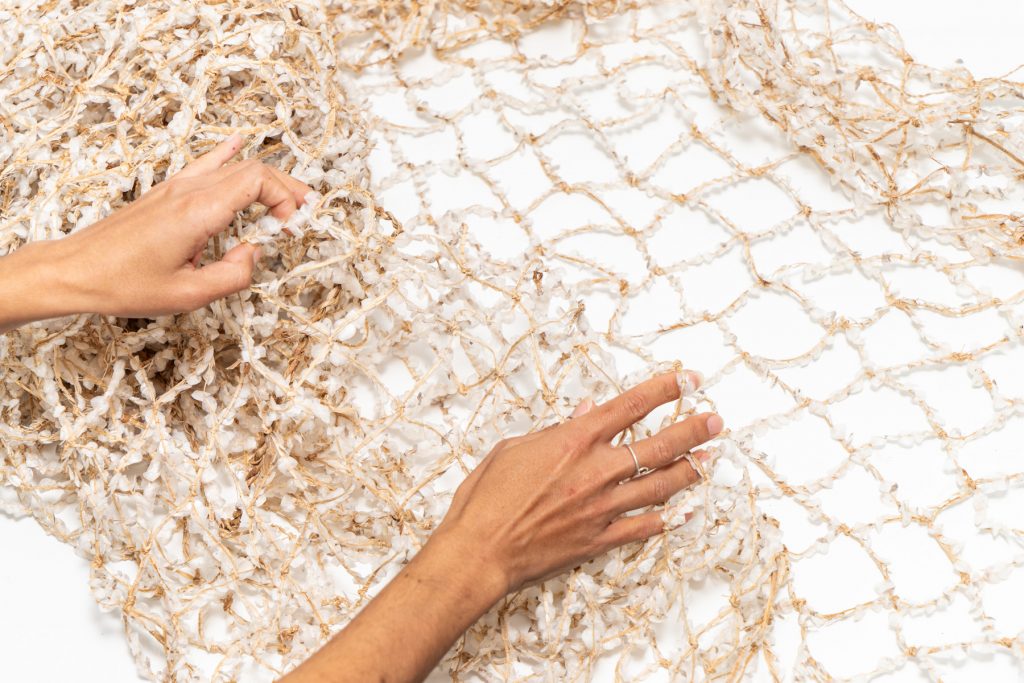
In keeping with the seasons, fibres including talwalpin (cotton tree) and ungaire (freshwater swamp reeds) have been carefully harvested on Country where they still grow strong today on our beautiful island home, Minjerribah, North Stradbroke Island.
Entwined are eugaries (pipis) and other gara (shells) and juru (mullet fish) scales gathered from the bay at Pulan, Amity Point and the ocean at Mooloomba, Point Lookout. These strands weave together the precious waterways of Country and significant food sources for our Quandamooka people. Juru and gara continue to provide sustenance for our people. They are also an extension of who we are as Saltwater people.
Woven string is a material which has sustained daily life for everyday, spiritual and ceremonial uses for First Nations people all over the world for Millenia. String can be woven using grasses, reeds, rushes, inner barks or vines rolled on the leg or hand twisted embedding the weavers body oils and Country into the fibres. They can be worn on the body, used to bind or carry.
Cyanotypes are hand painted and soaked into gara developed using sunshine creating embodiments of the deep blue waterways. Gara come from the living springs of Mother Earth and contribute to our wellbeing. The watery gara mirror clouds as the fish scales glisten like strings of shooting stars connecting the seas to Ancestral skies.
These materials are woven together symbolising the strong relationships between First Nations people, land, sky, sea, ecosystems and the space in between. This bond is grounded in Country and is unbreakable. These strings weave Ancestral hands into the present. The thread that binds us is Country.
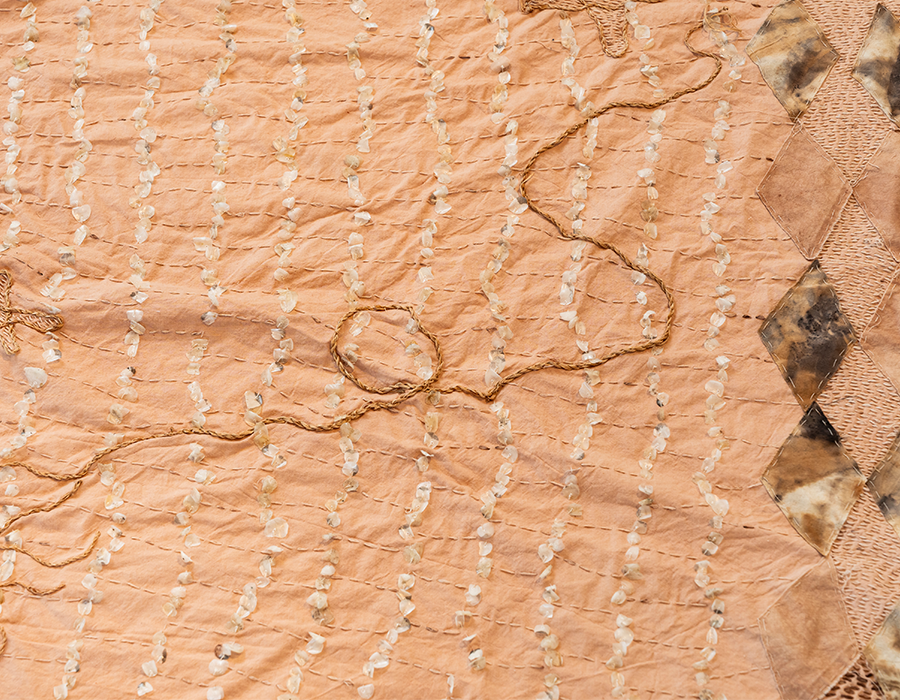
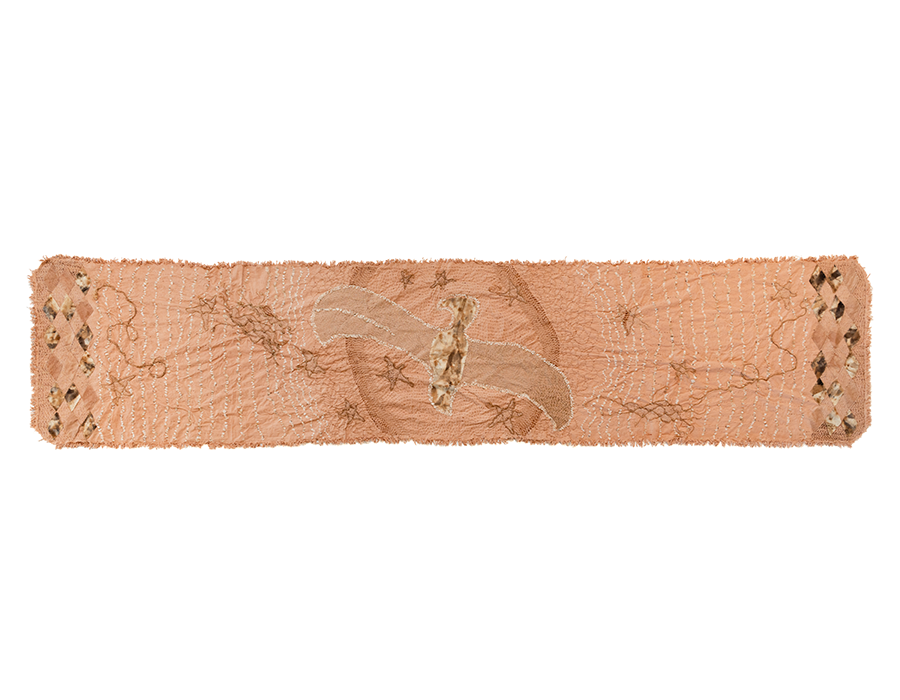
Elisa Jane Carmichael, Ruth Emery Highly Commended Award in the 2025 Wangaratta Contemporary Textile Award
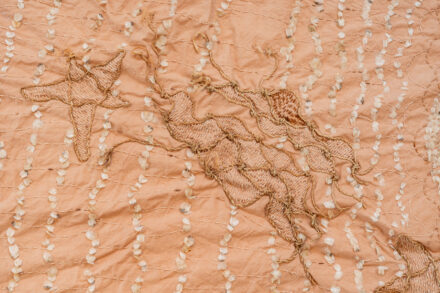
Elisa Jane ‘Leecee’ Carmichael’s works capture an essence of Quandamooka Country, the saltwater landscape of the Nunukul, Ngugi and Goenpul people, centred on the great sand islands of Minjerribah and Mulgumpin and the bay and islands to the east of Brisbane. They speak to the energies of water, waves, tides, wind and shifting sand; to the energies of song, dance and stories that imbue the landscape with meaning; and to the entities, from great ancestors to present-day family, who continue to occupy their extraordinary piece of the Earth.
Mirrigimpa, the sea eagle, is of great significance to Quandamooka people, providing knowledge of sustainable and communal hunting and fishing practices and embodying Ancestral cultural practices. Mirrigimpa sings with the changing tides, signalling when the mullet are coming and carries spiritual and cultural connections to sea and sky Country:
“When loved ones pass and return to Mother Earth, Mirrigimpa carries their soul up to sky Country with mirrigin (the stars), our Ancestors.”
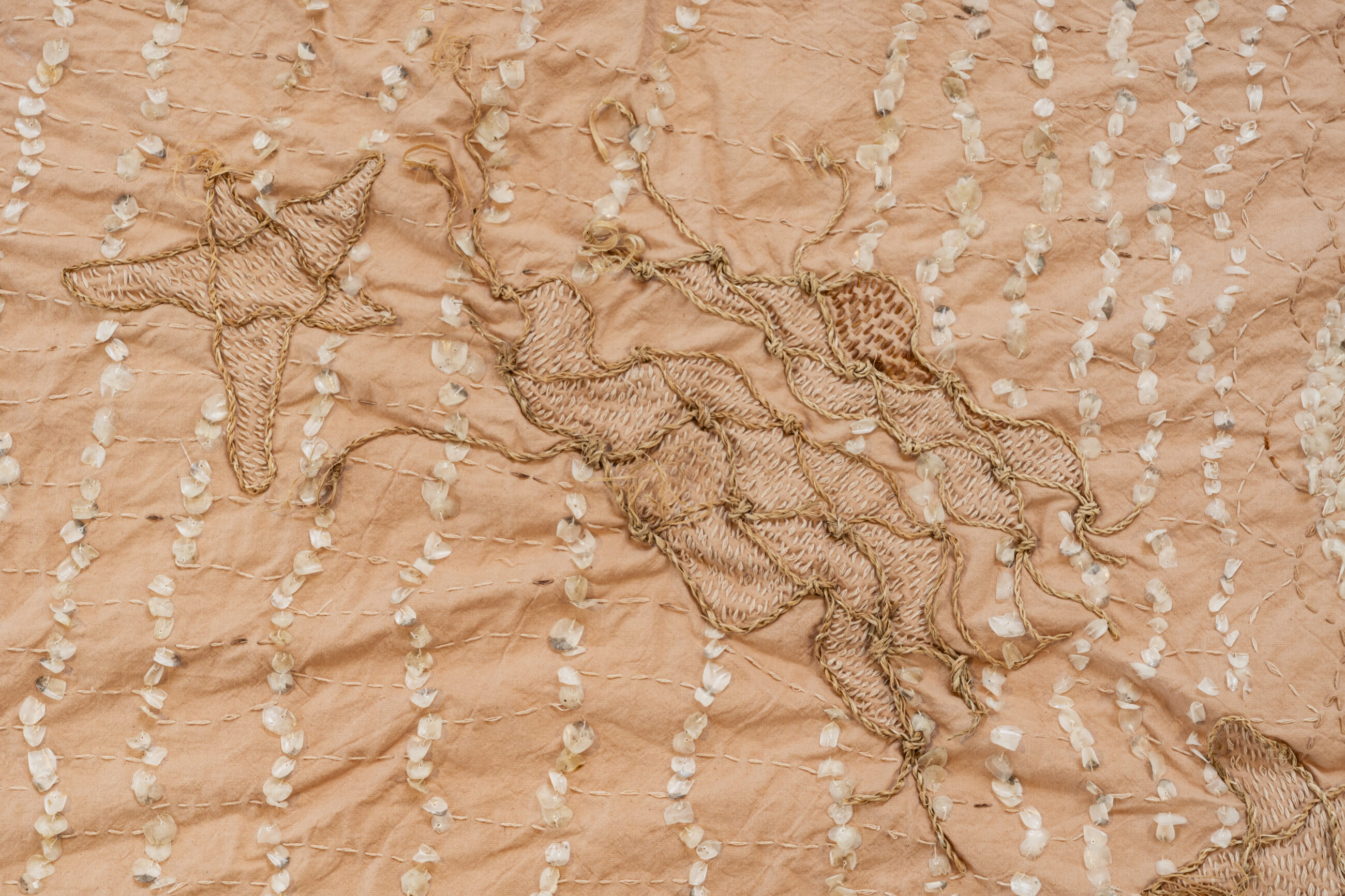
Handstitched and dyed with mangrove bark and eucalyptus leaves, Mirrigimpa incorporates mullet fish-scales, string, Talwalpin nets and scent from eucalyptus, banksia, casuarina and melaleuca leaves. Stripped and woven into string, the inner bark fibre of Talwalpin (cotton tree) has been used for millennia to make nets and baskets. Together the materials and methods of Mirrigimpa carry the scent and memories of Country while imagining Mirrigimpa’s vision, soaring across Quandamooka waters.
Marian Drew, Short Listing for the STILL: National Still Life Award 2025
TILL: National Still Life Award is Yarrila Arts and Museum’s biennial acquisitive art award, established in 2017 to support and showcase contemporary still life practice. The award aims to highlight the diversity, innovation and ongoing relevance of this genre across a wide range of media.
Prita Tina Yeganeh, 2025 Outer Space and Composite Moving Image Commission
The 2025 Outer Space and Composite Moving Image Commission awarded to Prita Tina Yeganeh, an artist whose practice spans installation, print, textile, and socially engaged methods to explore the emotional and physical geographies of forced migration.
Grounded in her lived experience as a refugee-migrant settler and informed by research into heritage crafts and environmental systems, Yeganeh’s work is characterised by sensitivity, rigour, and a profound sense of care.
This commission offers a timely opportunity to support the development of her moving image practice through the creation of a deeply personal and politically resonant project that uses the act of learning a Persian recipe as a lens to examine diasporic grief, transgenerational knowledge, and the fractured intimacies of life lived across borders.
Prita Tina Yeganeh, Winner of the 47th Walyalup Fremantle Arts Centre Print Award
Prita Tina Yeganeh wins the 2025 Walyalup Freemantle Arts Centre Print Award.
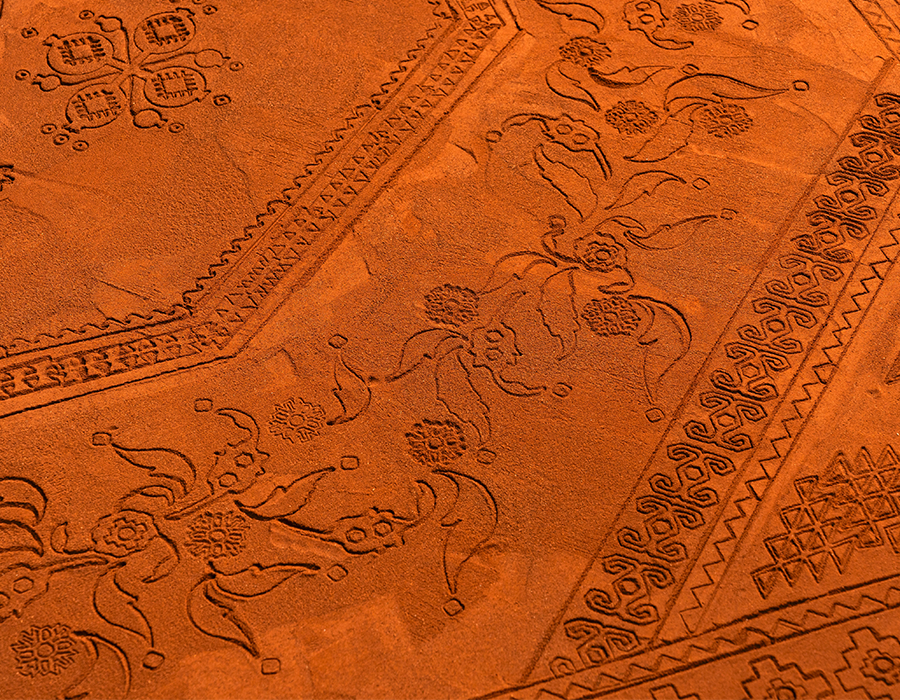
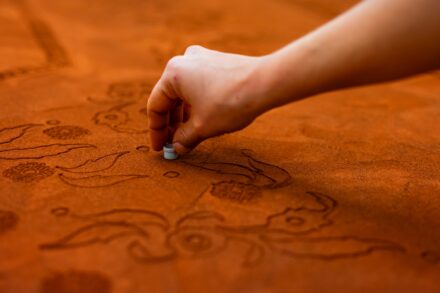 Her work ‘My Soil Farsh فرش’ : Iteration 2 (The Sacred Shared Labour)’ is a stunning printed work, measuring 200cm x 170cm, and comprising 45 kilograms of red, loamy clay soil, hand-ground over 145 hours by Prita and her community collaborators.
In accepting the Award, Prita said that “I’m so grateful to the Walyalup Fremantle Arts Centre and the judges for this recognition. My Soil Farsh sits very close to my heart, reflecting the collaboration, labour, and cultural stories of my community. It’s a proud moment for me as a creative, and I share this success with so many in my community back home.”
The 2025 WFAC Print Award exhibition comprises 68 works that have been selected by an esteemed judging panel that includes Dr Jessyca Hutchens (Co-Director at the Berndt Museum, UWA), Hannah Mathews (Director/ CEO, Perth Institute Contemporary Art) & artist, printer and publisher Trent Walter (Negative Press, Naarm Melbourne).
This is an acquisitive award, with the winner being awarded $20,000. Our sincere thanks to the judging panel and all the Walyalup Fremantle Arts Centre team.
Teddy Horton, The Churchie Prize Finalist
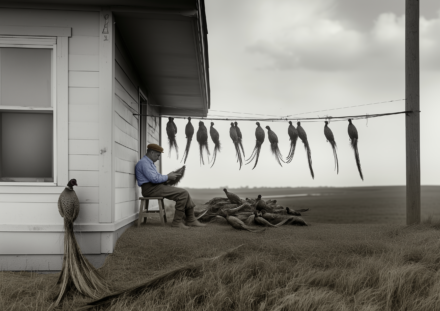
Through her precisely crafted, one-hundred percent AI-generated short video works, Horton subverts character stereotypes and storytelling expectations. Her work is disarmingly funny and poetic, while applying an ironic and self-reflexive lens on the inherent tension of creating art using generative AI.
Horton’s AI video piece ‘Stars Align’ won the Emerging Artist category at the 2024 Queensland Regional Arts Awards. Her digital collage works featured in the 2023 Horizon Festival, and her photographic portrait ‘Rabbit Phone’ was Highly Commended in the 2021 Next Gen Brisbane Portrait Prize.
As a creator, advocate, and critic deeply engaged in the world of generative AI, my practice embraces both the incredible creative potential and the vexed controversies that surround these rapidly evolving platforms.
The Reaper dives headfirst into the cultural rollercoaster that is 2025 America. It poses big questions about the relentless industrial harvesting of artists’ work to feed generative AI engines, but it is also a joyous celebration of creativity. The creative process is experimental and iterative, prompting, training, editing, and refining content across several platforms. Rather than trying to simulate realism, the work actively highlights and celebrates generative AI’s limitations and mistakes.
Generative AI platforms are reshaping arts practice in fundamental ways, and there is an opportunity to inform its development through analysis of the history of technologies like photography. Inspired by photo colourisation techniques from 1850s Japan, The Reaper combines AI-generated black and white images with manual colouring techniques. The still images are animated into short video sequences and edited to an AI-generated music track.
Zoe Porter, finalist for Brisbane Portrait Prize
 Zoe Porter is an interdisciplinary artist based in Meanjin. Working across drawing, painting, installation, performance, and sculpture, her artworks often illustrate hybridised animal-human forms that merge chaos and order.
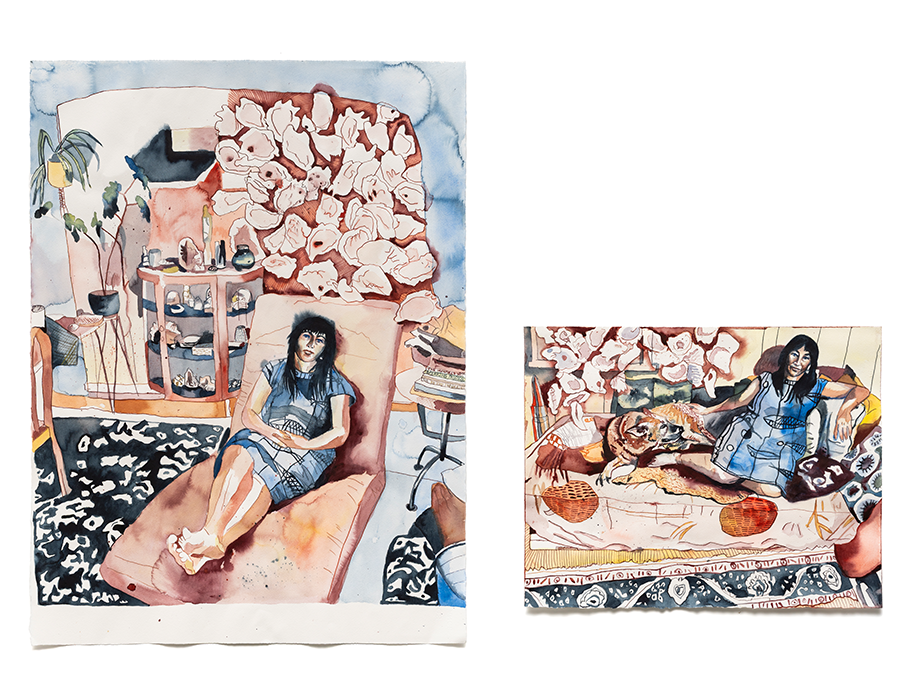
‘Megan at Woolloongabba’ is a diptych portrait of Quandamooka artist, Megan Cope, who is Porter’s friend of nearly 20 years. Porter writes, “This artwork attempts to capture both aspects of her: one side of her as the focused, determined artist in the studio, and the other as a more relaxed, dreamlike depiction of her… I’ve always admired her work and I think she’s one of the best Australian contemporary artists out there.”
The Brisbane Portrait Prize is a celebration of Brisbane portrait artists and their sitters, encouraging public engagement with arts. You can visit the finalist exhibition at L2 slq Gallery at State Library of Queensland from 20 September to 9 November.
Zoe Porter, Libris Awards 2025
Mutations is an experimental and playful artist book and is an extension of Porter’s current practice, which explores depictions of hybrid forms to investigate the subconscious and experiences of dislocation. The mixed-media book is made up of fragments of imagery, partly figurative and partly abstract, following a kind of illogical dream sequence.
The book is double-sided and reveals small scenes of imagery including portraits of ghostly figures, shoes and jackets with protrusions of fur and animal-like tails. The book can be read left to right or right to left as well as vertically or horizontally. The artist has employed a combination of printmaking, watercolour and drawing, and each panel features textured mark-making, line and ambiguous repeated forms and shapes to direct the viewer across and inside the book. The deliberate use of repetition and varied forms allows for an open-ended reading and suggested narrative to occur.
Sam Harrison, Highly Commended, Sunshine Coast Art Prize 2025
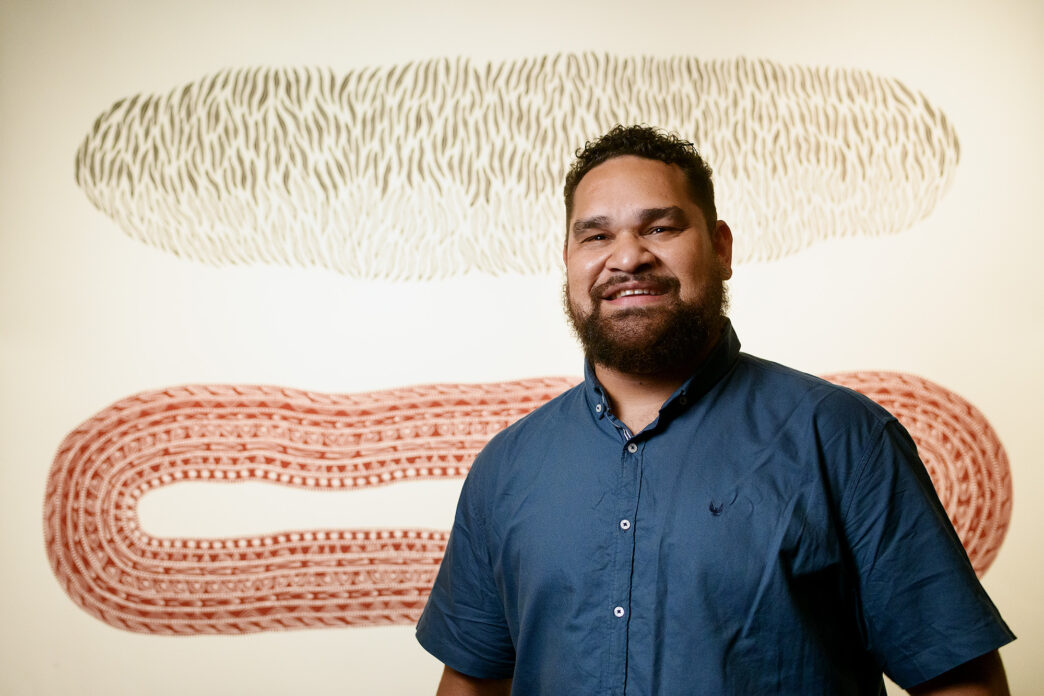
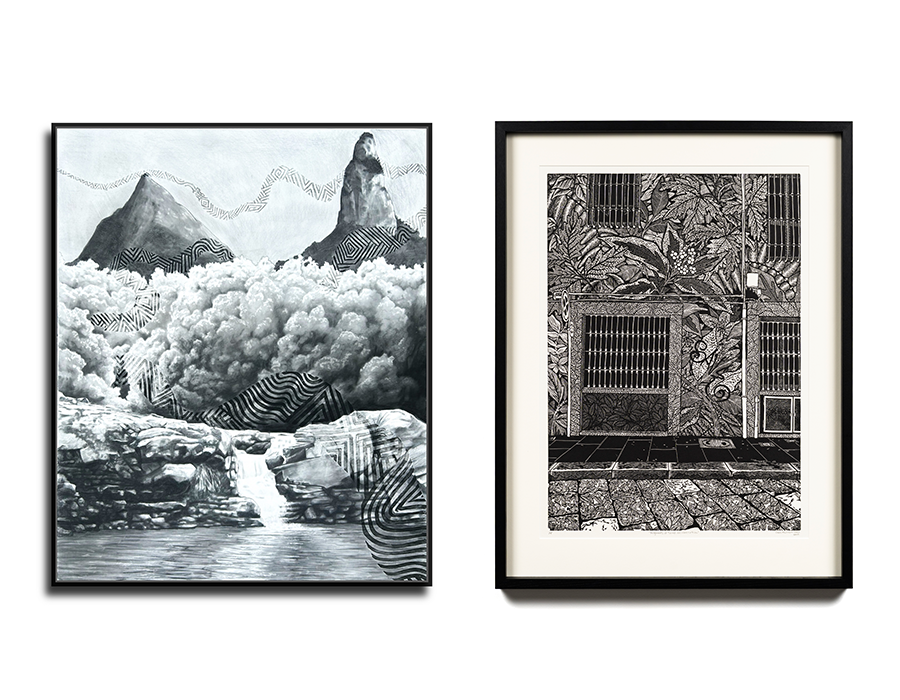
Born Here, From There is a depiction of the metaphysical connections that create belonging. Travelling through the landscape is a pattern connecting the artists place of birth with their ancestral home. The work explores the sense of being known by the land and being grounded by the memory it holds.
Tamika Grant-Iramu, Finalist, Sunshine Coast Art Prize 2025
Fragments of Torino: an observation draws on my impressions and experiences during a residency program in Torino (Italy) in late 2023. Using printmaking as a tool to capture my visceral impressions of place, I found myself responding to the organic forms that interact with the built environment of the city. While exploring Torino, I gravitated towards intimate observations of the old Italian architecture. The delicate engraved details that characterise these buildings are being worn away over time while also being layered with new and unexpected details. As I observed these buildings I was fascinated by the textures and movement of both nature and graffiti and how it redefines the way the architecture is experienced. There is a continuity within the evolving environment of this building as people and nature add to its story.